PRODUCTION AND PROPERTIES OF LOW-DENSITY ALKALI-ACTIVATED COMPOSITIES BY INCORPORATION OF EXPANDED POLYSTYRENE (EPS)
DOI:
https://doi.org/10.5281/zenodo.7213553Abstract
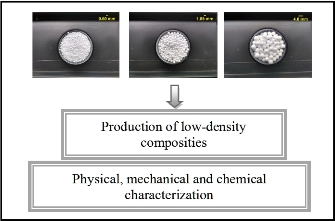
The increasing consumption of Portland cement raised concerns about the large amount of CO2 generated during its production, Alkali-Activated Materials (AAM) being an alternative for its replacement in some applications. This research investigated the production of lightweight Alkali-Activated Composites (AAC), based on metakaolin and expanded polystyrene (EPS) as an agglomerate. The effects of the amount and size of EPS incorporated in the matrix (18, 35, and 53vol.-% and varied average sizes of 0.85, 2.16, and 6.00 mm) were evaluated. Increasing amounts of EPS reduced strength, from 42 MPa to 25 or 14 MPa for 18 or 53vol.-% of beads of size 0.85 mm. Strength decrease is more pronounced for larger EPS beads, i.e. to 12.2 and 1.5 MPa when 18 or 53vol.-% EPS beads with an average diameter of 6.0 mm were added. However, composites with a density as low as 0.8 to 1.2 g/cm3 were produced with strength varying between 15 and 25 MPa, demonstrating their potential as construction materials for non-structural applications.Downloads
Download data is not yet available.
Downloads
Published
2022-10-24
How to Cite
de Souza Azevedo, A. G., Torga Lombardi, C., Tonholo Domingos, L. F., & Strecker, K. (2022). PRODUCTION AND PROPERTIES OF LOW-DENSITY ALKALI-ACTIVATED COMPOSITIES BY INCORPORATION OF EXPANDED POLYSTYRENE (EPS). LatinAmerican Journal of Metallurgy and Materials, 42(1), 03–19. https://doi.org/10.5281/zenodo.7213553
Issue
Section
Regular Articles
License
The authors of papers accepted for publication by the RLMM, should recognize the complete transfer of copyright (in all languages) to the RLMM. This transfer includes the right by the RLMM to adapt the article for digital or printed reproduction without altering the written content and information displayed in tables or figures within. The authors retain the copyright and guarantee the journal the right to be the first publication of the work as well as licensed under a Creative Commons Attribution License 4.0 Internacional (CC BY 4.0) which allows others to share the work with an acknowledgment of the authorship of the work and the initial publication in this journal.