THERMALLY STIMULATED PROCESS IN A CERAMIC IONIC CONDUCTOR BY TSDC TECHNIQUE
DOI:
https://doi.org/10.5281/zenodo.10032023Abstract
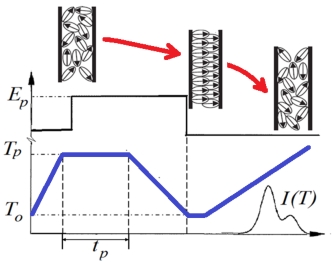
The thermally stimulated processes in a pyrochlore-type ceramic ionic conductor were examined by the thermally stimulated depolarization current (TSDC) technique. Three polarization processes have been found in the thermogram. The first one, revealed to result from the convolution of three simple processes with approximately similar activation energies value and can be basically attributed to the reorientation of cation-anion dipoles by means of nearest-neighbor (NN) to nearest-neighbor jumps (that is to say, a NN → NN relaxation type). The second process originated most likely also from a dipolar mechanism now involving nearest-neighbor to next-nearest-neighbor relaxation processes (NN→ NNN relaxation type). On the other hand, the third process has been related to a space-charge relaxation, arising from the migration of K+ free-charge carriers. The activation energies and the pre-exponential factors for all these mechanisms were also reported.Downloads
Download data is not yet available.
Downloads
Published
2015-06-29
How to Cite
Alvarez, R., Londono, F. A., & Guerrero, F. (2015). THERMALLY STIMULATED PROCESS IN A CERAMIC IONIC CONDUCTOR BY TSDC TECHNIQUE. LatinAmerican Journal of Metallurgy and Materials, 20–25. https://doi.org/10.5281/zenodo.10032023
Issue
Section
Regular Articles
License
The authors of papers accepted for publication by the RLMM, should recognize the complete transfer of copyright (in all languages) to the RLMM. This transfer includes the right by the RLMM to adapt the article for digital or printed reproduction without altering the written content and information displayed in tables or figures within. The authors retain the copyright and guarantee the journal the right to be the first publication of the work as well as licensed under a Creative Commons Attribution License 4.0 Internacional (CC BY 4.0) which allows others to share the work with an acknowledgment of the authorship of the work and the initial publication in this journal.