TOPOGRAPHICAL SURFACE ANALYSIS OF PASTE AND CONCRETE MADE WITH BLENDED COMMERCIAL CEMENT
DOI:
https://doi.org/10.5281/zenodo.10031584Abstract
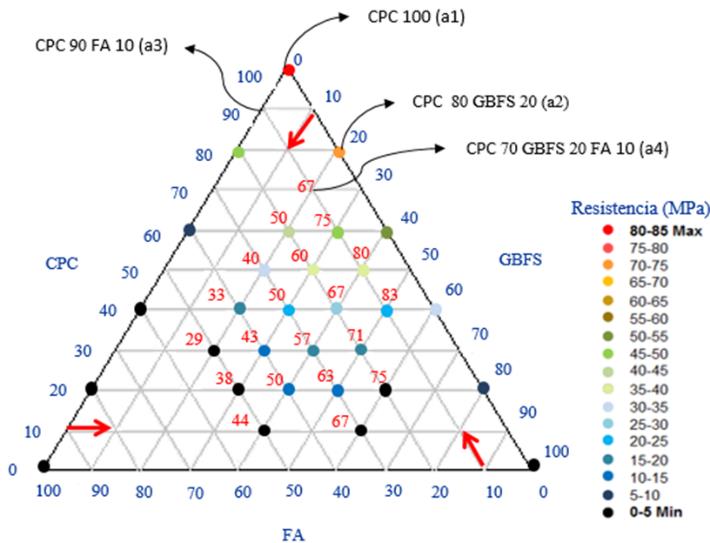
This paper presents the findings of the evaluation of the properties of cementing materials elaborated by mixing commercial Portland cement (CPC), fly ash (FA) and blast furnace slag (GBFS). Initially, a total of 30 different samples of mixes were evaluated in terms of compressive strength in order to determine the optimal proportions of binary and tertiary mixtures of the raw materials. As a result, four representative blends of the optimal combinations were characterized during the setting and hardening process. The compressive strength development of mortar and concrete samples was studied. The findings of this analysis show that the commercial cement blended with fly ash and blast furnace slag presents a decrease in the mechanical strength behaviour regarding to CPC, because of the existing additions incorporated by the manufacturer, which decreased the possibility of FA and GBF reactions. Finally, concrete and cementing pastes were analysed with a high resolution microscope during different ages. The superficial topographic analyses of the mortar allow us to relate the cementitious capacities of the materials with the topographic details, highlighting the high topographic intensity and low uniformity in the mortar with the addition of FA and GBFS. The cementing material corresponded to the one used in mortars and concrete which got the lowest strength results in the compression test.Downloads
Download data is not yet available.
Downloads
Published
2016-01-08
How to Cite
Gutiérrez-Junco, O. J., Pineda-Triana, Y., & Vera-López, E. (2016). TOPOGRAPHICAL SURFACE ANALYSIS OF PASTE AND CONCRETE MADE WITH BLENDED COMMERCIAL CEMENT . LatinAmerican Journal of Metallurgy and Materials, 168–184. https://doi.org/10.5281/zenodo.10031584
Issue
Section
Regular Articles
License
The authors of papers accepted for publication by the RLMM, should recognize the complete transfer of copyright (in all languages) to the RLMM. This transfer includes the right by the RLMM to adapt the article for digital or printed reproduction without altering the written content and information displayed in tables or figures within. The authors retain the copyright and guarantee the journal the right to be the first publication of the work as well as licensed under a Creative Commons Attribution License 4.0 Internacional (CC BY 4.0) which allows others to share the work with an acknowledgment of the authorship of the work and the initial publication in this journal.