MODELLIZATION OF THE PROCESS OF NATURAL AGING OF A POLYMER MATERIAL APPLIED FOR GREENHOUSE COVERS
DOI:
https://doi.org/10.5281/zenodo.8217956Abstract
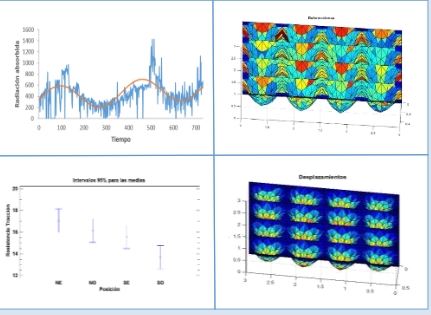
It is presented a procedure to determine the aging of greenhouse cover materials constituted by a polymer material. For this purpose, it is performed a continued monitoring of the photosynthetically active radiation (PAR) and the global radiation during three campaigns. It has been studied in this research samples taken at different zones of the cover, after breakage using mechanical traction. It is deduced a useful life of the polymer of two years, being the average transmitted PAR of 37.44%. However, the absorbed global radiation is determined a value of 36.29%. Furthermore, the elongation to the breakage is above of 500%. This high value is associated to an intense degradation of the polymer material. At the same time, the zone where the sample was taken seems to influence both the strength of mechanical traction and the elongation at the fluence point. The designed tests have been useful to develop a modellization procedure based on the minimum squared method for the adjustment of the data. The proposed model can be used for the design of greenhouse covers and thus allows predict the degree of deterioration of the polymer material at every moment. It is also interesting to keep watch of the need of removing it. The numerical simulations using the finite elements method can represent adequately the mechanical behavior of the cover material. It is been also deduced in this research that the behavior of the covers is at the plastic zone of material.Downloads
Download data is not yet available.
Downloads
Published
2016-10-21
How to Cite
Garzón, E., Ortiz, I. M., Sánchez-Soto, P. J., Castillo, J. C., & Rojano, A. (2016). MODELLIZATION OF THE PROCESS OF NATURAL AGING OF A POLYMER MATERIAL APPLIED FOR GREENHOUSE COVERS. LatinAmerican Journal of Metallurgy and Materials, 60–82. https://doi.org/10.5281/zenodo.8217956
Issue
Section
Regular Articles
License
The authors of papers accepted for publication by the RLMM, should recognize the complete transfer of copyright (in all languages) to the RLMM. This transfer includes the right by the RLMM to adapt the article for digital or printed reproduction without altering the written content and information displayed in tables or figures within. The authors retain the copyright and guarantee the journal the right to be the first publication of the work as well as licensed under a Creative Commons Attribution License 4.0 Internacional (CC BY 4.0) which allows others to share the work with an acknowledgment of the authorship of the work and the initial publication in this journal.