EFFECT OF THE ADDITION OF CERIUM NITRATE AND THE AGING TIME DURING THE SYNTHESIS OF HYBRID TEOS-GPTMS SOL-GEL COATINGS ON THE AA2050-T8 ALUMINIUM ALLOY
DOI:
https://doi.org/10.5281/zenodo.8217683Abstract
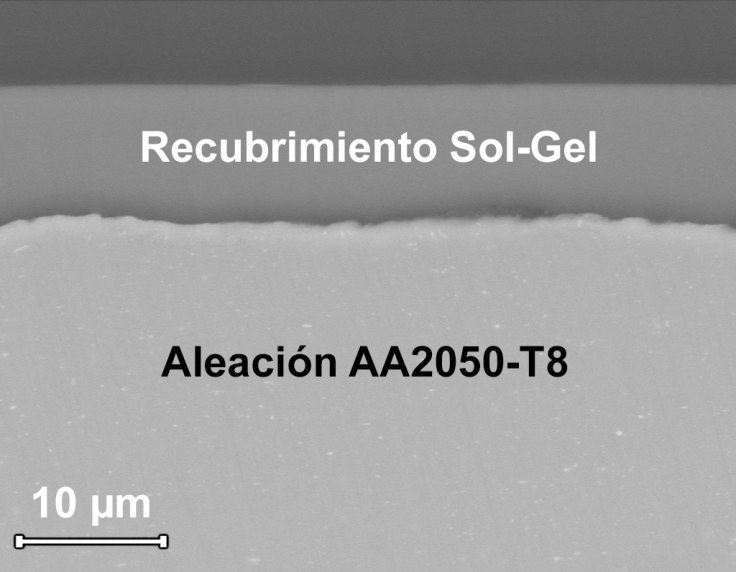
In the present work, the effect of the addition of the corrosion inhibitor cerium nitrate (Ce(NO3)3·6H2O) and the aging time were evaluated during the synthesis of hybrid sol-gel coatings applied on the AA2050-T8 aluminium alloy. Sols were prepared from a mixture of the precursors tetraethylorthosilicate (TEOS) and glycidoxypropyltriethoxysilane (GPTMS) in a molar ratio TEOS:GPTMS of 3:1, using acetic acid and ethanol as catalyst and solvent respectively. The hydrolysis and condensation process of the hybrid sols was monitored by Fourier Transform Infrared (FTIR) Spectroscopy and rheological tests, whereas sol-gel coatings were characterized using attenuated total reflectance infrared spectroscopy (FTIR-ATR), scanning electron microscopy (SEM), contact angle measurements, and scratch tests. The experimental results showed that the physicochemical characteristics of the hybrid sol-gel coatings obtained were influenced by both the aging time and the addition of the corrosion inhibitor. In this regard, an increase of the aging time resulted in uniform coatings with an adequate adhesion and greater hydrophobic features. On the other hand, the effect of the addition of cerium nitrate in the gelation process was more significant, producing coatings with superior physicochemical features, even for short aging times.Downloads
Download data is not yet available.
Downloads
Published
2017-02-18
How to Cite
Remolina Galvis, E. N., Hernández-Barrios, C. A., Coy Echeverrí, A. E., Viejo Abrante, F., & Alba de Sanchez, N. C. (2017). EFFECT OF THE ADDITION OF CERIUM NITRATE AND THE AGING TIME DURING THE SYNTHESIS OF HYBRID TEOS-GPTMS SOL-GEL COATINGS ON THE AA2050-T8 ALUMINIUM ALLOY. LatinAmerican Journal of Metallurgy and Materials, 147–159. https://doi.org/10.5281/zenodo.8217683
Issue
Section
Regular Articles
License
The authors of papers accepted for publication by the RLMM, should recognize the complete transfer of copyright (in all languages) to the RLMM. This transfer includes the right by the RLMM to adapt the article for digital or printed reproduction without altering the written content and information displayed in tables or figures within. The authors retain the copyright and guarantee the journal the right to be the first publication of the work as well as licensed under a Creative Commons Attribution License 4.0 Internacional (CC BY 4.0) which allows others to share the work with an acknowledgment of the authorship of the work and the initial publication in this journal.