KINETIC STUDY OF PHASE PRECIPITATION OF AN AA7075 ALLOY UNDER T6 AND T7 TEMPER
DOI:
https://doi.org/10.5281/zenodo.8217691Abstract
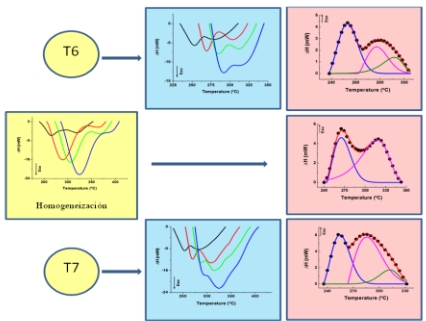
T6 and T7 tempers are used to reinforce the mechanical strength and resistance to stress cracking of the aluminum alloys of the 7000 series .This is achieved because such treatments regulate the dissolution and precipitation of various precipitates which varies the volume fraction inside and the grain boundaries. Hitherto have been used DSC measurements to characterize the different exo and endothermic transformations, which are associated With precipitation and dissolution of phases that Occur during that process, relapsing on the reaction peak values the principal weight of the characteristic thermal analysis. While this is true on simple reactions, on typical complex reactions of multicomponent alloys these peaks are the result of numerous processes. So far in the literature best experimentally defined peaks correspond to phase dissolution reactions, being frequently reported their kinetic parameters, but not for the parameters of the precipitation reaction. Hence it aims to study the kinetics of precipitation of phases η',η and S on an AA7075 alloy subjected to the T6 and T7 tempers through deconvolution of the peaks obtained by DSC. Asymmetric transfer functions of Weibull and the Sestak-Berggren kinetic model combined with the isoconversion method to determine the kinetic parameters of each reaction are used. Through these parameters it is established that the pattern of precipitation of the η phase is similar for both temper, but not for the h and S phases, being the physical mechanism responsible of precipitation of these phases predominantly the migration of alloying elements favored by the initial pre-precipitation of Guinier Preston zones, serving as precursor of subsequent processes.Downloads
Download data is not yet available.
Downloads
Published
2017-01-14
How to Cite
Luiggi A., N. J., & Valera M., M. del V. . (2017). KINETIC STUDY OF PHASE PRECIPITATION OF AN AA7075 ALLOY UNDER T6 AND T7 TEMPER. LatinAmerican Journal of Metallurgy and Materials, 160–178. https://doi.org/10.5281/zenodo.8217691
Issue
Section
Regular Articles
License
The authors of papers accepted for publication by the RLMM, should recognize the complete transfer of copyright (in all languages) to the RLMM. This transfer includes the right by the RLMM to adapt the article for digital or printed reproduction without altering the written content and information displayed in tables or figures within. The authors retain the copyright and guarantee the journal the right to be the first publication of the work as well as licensed under a Creative Commons Attribution License 4.0 Internacional (CC BY 4.0) which allows others to share the work with an acknowledgment of the authorship of the work and the initial publication in this journal.