SOLID-STATE SYNTHESIS AND CHARACTERIZATION OF MAGNESIUM AND ZINC DOPED TRICALCIUM PHOSPHATE
DOI:
https://doi.org/10.5281/zenodo.8217843Abstract
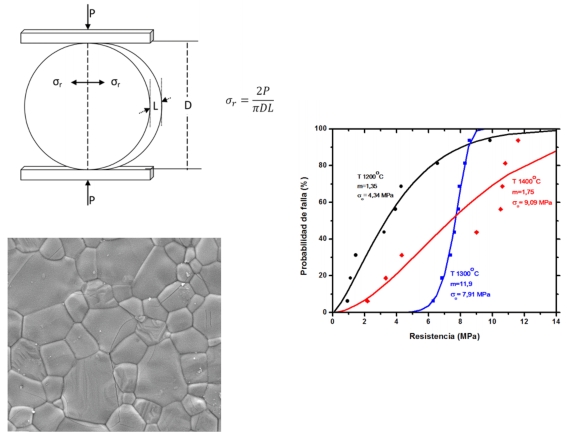
The development of bioceramics for structural applications is limited by its toughness and strength. These limitations lead to investigations seeking to improve their mechanical performance by doping similar to those present in human bone and materials that do not generate reactions or toxic elements, such as CO32-, SiO44-, Mg2+, Zn2+, F-, Cl-, Ag+, Na+ y K+. In this context, the present investigation was focused on the synthesis of tricalcium phosphate (TCP) doped with magnesium Mg2+ and zinc Zn2+, by sintering in solid state, adding them in the form of oxides as follows M-1 (1 wt% Mg, 1 wt% Zn), M-4 (4 wt% Mg, 1 wt% Zn) y M-7 (7 wt% Mg, 1 wt% Zn), by mixture of raw materials, calcination at 900°C and sintering at 1200, 1300 and 1400°C. The microstructural characterization was carried out by MEB, compositional by XRD and elemental by EDX, where it was determined that the major phase was β-TCP as proposed and that the change of the β → α-TCP phase is only introduced 1400°C. Additionally, a study of in vitro behavior in simulated body fluid (SBF) was performed, showing the low formation of apatite on the surface during the immersion of 28 days. Finally, a mechanical study was conducted by the diametral compression test on disk specimen diameter 10,0 ± 0,3 mm and thickness 2,8 ± 0,2 mm, where a slight increase compared with phosphates resistance offered commercially observed.Downloads
Download data is not yet available.
Downloads
Published
2017-04-23
How to Cite
García Páez, I. H., Ardila Melo, R., & Pinzón-Bedoya, M. L. (2017). SOLID-STATE SYNTHESIS AND CHARACTERIZATION OF MAGNESIUM AND ZINC DOPED TRICALCIUM PHOSPHATE. LatinAmerican Journal of Metallurgy and Materials, 258–266. https://doi.org/10.5281/zenodo.8217843
Issue
Section
Regular Articles
License
The authors of papers accepted for publication by the RLMM, should recognize the complete transfer of copyright (in all languages) to the RLMM. This transfer includes the right by the RLMM to adapt the article for digital or printed reproduction without altering the written content and information displayed in tables or figures within. The authors retain the copyright and guarantee the journal the right to be the first publication of the work as well as licensed under a Creative Commons Attribution License 4.0 Internacional (CC BY 4.0) which allows others to share the work with an acknowledgment of the authorship of the work and the initial publication in this journal.