SYNTHESIS AND CHARACTERIZATION OF POLYETHYLENES OBTAINED FROM ZIEGLER-NATTA (ZN) CATALYSTS BASED ON MONO AND BIMETALLIC SPECIES SUPPORTED IN A TYPE ADDITIVE MgCl2/SiCl4-n(OHEx)n.
DOI:
https://doi.org/10.5281/zenodo.7893453Abstract
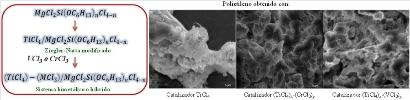
In this work, Ziegler-Natta (ZN) catalysts based on species supported in an adduct of the type MgCl2/SiCl4-n(OHex)n to polymerize ethylene were evaluated. Also, the polyethylenes obtained with mono and bimetallic systems were characterized by Differential Scanning Calorimetry (DSC), thermogravimetric analysis (TGA), scanning electron microscopy (SEM) and transmission electron microscopy (TEM). The thermal properties of the PE (Tm between 131-136 °C and (1-λ) between 58-64%) were found in the range for high density polyethylenes. The TGA results showed that the polyethylenes derived from the catalysts TiCl4 and (TiCl4)x-(VCl3) begin their degradation at higher ranges than the polyethylene synthesized with the catalyst (TiCl4)x-(CrCl3), indicating that the presence of chromium in the latter gave it lower thermal stability. A sponge-like morphology was observed in the polyethylene obtained with the TiCl4/MgCl2/SiCl4-n(OHex)n catalyst system, which varied by adding another metal center (Cr and V) to a globular type morphology (bunch of grapes). In the micrographs of the polyethylenes obtained by TEM, the lamellar town were observed decreasing in the following order: PETi (11,7 a 23,3 nm) < PETi/V (8,3 a 16,7 nm) < PETi/Cr (5,0 a 16,7 nm).Downloads
Download data is not yet available.
Downloads
Published
2019-12-22
How to Cite
Tenia, R., Morrillo, Ángel, Chirinos, J., Ibarra, D., Sánchez, Y., & Rojas de Gáscue, B. (2019). SYNTHESIS AND CHARACTERIZATION OF POLYETHYLENES OBTAINED FROM ZIEGLER-NATTA (ZN) CATALYSTS BASED ON MONO AND BIMETALLIC SPECIES SUPPORTED IN A TYPE ADDITIVE MgCl2/SiCl4-n(OHEx)n. LatinAmerican Journal of Metallurgy and Materials, 146–155. https://doi.org/10.5281/zenodo.7893453
Issue
Section
Regular Articles
License
The authors of papers accepted for publication by the RLMM, should recognize the complete transfer of copyright (in all languages) to the RLMM. This transfer includes the right by the RLMM to adapt the article for digital or printed reproduction without altering the written content and information displayed in tables or figures within. The authors retain the copyright and guarantee the journal the right to be the first publication of the work as well as licensed under a Creative Commons Attribution License 4.0 Internacional (CC BY 4.0) which allows others to share the work with an acknowledgment of the authorship of the work and the initial publication in this journal.