EFFECT OF RESIN AND ASPHALTENE CONTENT PRESENT ON THE VACUUM RESIDUE ON THE YIELD OF DELAYED COKING PRODUCTS (EFECTO DEL CONTENIDO DE RESINAS Y ASFALTENOS PRESENTE EN EL RESIDUO DE VACIO SOBRE EL RENDIMIENTO DE LOS PRODUCTOS DE LA COQUIZACIÓN RETARDADA)
EFECTO DEL CONTENIDO DE RESINAS Y ASFALTENOS PRESENTE EN EL RESIDUO DE VACIO SOBRE EL RENDIMIENTO DE LOS PRODUCTOS DE LA COQUIZACIÓN RETARDADA
DOI:
https://doi.org/10.5281/zenodo.7693790Abstract
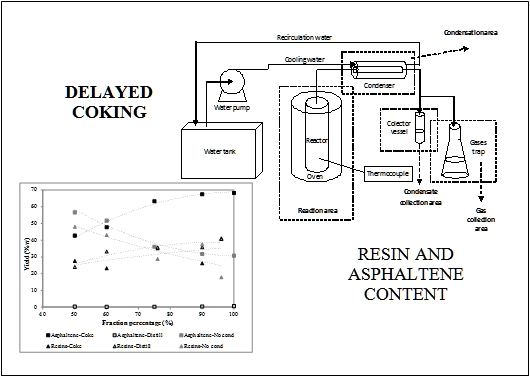
The effect of resin and asphaltene concentration in the feed, on the yield of delayed coking products was assessed, feeding controlled concentrations of the groups: saturates, aromatics, resins and asphaltenes (SARA) (50-100%w/w of asphaltene or resin and a fixed mass ratio of the others groups) prepared from a Venezuelan vacuum residue. The results of yield of products obtained in a laboratory-scale process show, that the increases of concentration of resins or asphaltenes raise yield of coke and decreasesthe not-condensable. The distillates yield remained at levels close to zero (<1%w/w) when asphaltene rich blends where fed, while in case of resin rich blends, the amount of distillate produced increased when the resins contents increased. These results are consequence of a higher condensation level of the molecules present in the crude. For distillates, a discriminatory behaviour occurred depending on in which fraction was rich the blend fed to the process, with yields in the order of 20-40% w/w for the mixtures rich in resins and practically equal to zero in the case of mixtures rich in asphaltenes.Downloads
Download data is not yet available.
Downloads
Published
2019-05-30
How to Cite
Pérez, N. A., Nava, A., Rincón, G., Meza, A., & Velásquez, J. (2019). EFFECT OF RESIN AND ASPHALTENE CONTENT PRESENT ON THE VACUUM RESIDUE ON THE YIELD OF DELAYED COKING PRODUCTS (EFECTO DEL CONTENIDO DE RESINAS Y ASFALTENOS PRESENTE EN EL RESIDUO DE VACIO SOBRE EL RENDIMIENTO DE LOS PRODUCTOS DE LA COQUIZACIÓN RETARDADA): EFECTO DEL CONTENIDO DE RESINAS Y ASFALTENOS PRESENTE EN EL RESIDUO DE VACIO SOBRE EL RENDIMIENTO DE LOS PRODUCTOS DE LA COQUIZACIÓN RETARDADA. LatinAmerican Journal of Metallurgy and Materials, 49–58. https://doi.org/10.5281/zenodo.7693790
Issue
Section
Regular Articles
License
The authors of papers accepted for publication by the RLMM, should recognize the complete transfer of copyright (in all languages) to the RLMM. This transfer includes the right by the RLMM to adapt the article for digital or printed reproduction without altering the written content and information displayed in tables or figures within. The authors retain the copyright and guarantee the journal the right to be the first publication of the work as well as licensed under a Creative Commons Attribution License 4.0 Internacional (CC BY 4.0) which allows others to share the work with an acknowledgment of the authorship of the work and the initial publication in this journal.