HYDROGENATION OF NATURAL OLEFINS WITH RUTHENIUM NANOPARTICLES STABILIZED IN IONIC LIQUIDS
DOI:
https://doi.org/10.5281/zenodo.7693689Abstract
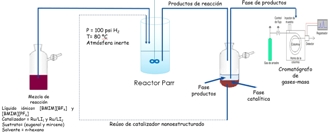
This study shows the catalytic evaluation for ruthenium nanoparticles stabilized in ionic liquids derived from imidazolium: LI1= butylmethylimidazolium tetrafluoroborate [BMIM][BF4] and LI2= butylmethylimidazolium hexafluorophosphate [BMIM][PF6] in the biphasic hydrogenation of myrcene and eugenol. The nanoparticles were synthesized using the method of reduction and displacement of ligand for tris(acetylacetonate) ruthenium (III) [Ru(acac)3], characterized through transmission electron microscopy (TEM), by which an average size of (2,0±0,2) nm, demonstrating that these catalysts are nanometric systems. Once these catalysts were used in the biphasic hydrogenation of eugenol, the production of 2- methoxy-4-propylphenol with 99% selectivity in a time of 4 hours could be observed, while in the biphasic hydrogenation of myrcene the formation of 6 hydrogenated species, the Ru/LI1 nanoparticles being more active and selective towards the formation of 7-methyl-3-methylene-6-octene in a time of 32 hours, in contrast to the Ru/LI2 nanoparticles were less active and selective generating a series of hydrogenated products.Downloads
Download data is not yet available.
Downloads
Published
2020-03-09
How to Cite
CRESPO, I., Domínguez, O., Baricelli, P., Borusiak, M., Omaña, O., & Rosales, M. (2020). HYDROGENATION OF NATURAL OLEFINS WITH RUTHENIUM NANOPARTICLES STABILIZED IN IONIC LIQUIDS. LatinAmerican Journal of Metallurgy and Materials, 3–14. https://doi.org/10.5281/zenodo.7693689
Issue
Section
Regular Articles
License
The authors of papers accepted for publication by the RLMM, should recognize the complete transfer of copyright (in all languages) to the RLMM. This transfer includes the right by the RLMM to adapt the article for digital or printed reproduction without altering the written content and information displayed in tables or figures within. The authors retain the copyright and guarantee the journal the right to be the first publication of the work as well as licensed under a Creative Commons Attribution License 4.0 Internacional (CC BY 4.0) which allows others to share the work with an acknowledgment of the authorship of the work and the initial publication in this journal.