EFFECT OF REPLACEMENT OF NATURAL SAND WITH BLASTED COPPER SLAG ON MORTARS PHYSICAL AND MECHANICAL PROPERTIES
DOI:
https://doi.org/10.5281/zenodo.7397130Abstract
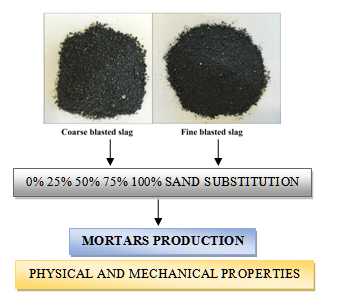
Environmental preservation is a widely discussed topic throughout society, due to heavy reliance on natural resources for survival on the planet. Rational use of raw materials and their proper disposal are on the agenda of the productive sectors’ major concerns. This work aimed toevaluate the feasibility of application of copper slag waste, after being used as an abrasive material, coming to be called blasted copper slag. It was intended to replace sand to blasted copper slag in mortars, into two fractions, named fine and coarse blasted slag sand, according to the number of times that were used in the abrasive process. Four mixtures were produced, for each type of blasted slag, with levels of 25%, 50%, 75% and 100% of replacement to natural sand, in addition to the reference mortar. The consistence of fresh mortars was measured by the flow table test and the spreading range was fixed for 270 ± 20 mm. Physical and mechanical tests were performed with produced mortars. Mortars with blasted copper slag, both fine and coarse slag, demanded lower water/binders ratio to achieve the desired spreading, compared to the reference mixture. Mechanical tests showed important performance reductions in compression strength of the mortars with fine blasted slag, both in relation to the reference mortar, and when compared to mortars with same replacement content of natural sand by coarse blasted slag. It could be concluded that, for levels between 25 and 50% of natural aggregate replacement by coarse blasted slag, there is feasibility of most mortarapplication, since there are not required high levels of strength and stiffness.Downloads
Download data is not yet available.
Downloads
Published
2021-06-18
How to Cite
Melo, R. L. S., Sales, A. T. C., Sales, D. C., & Pessoa Betânio Oliveira, R. M. (2021). EFFECT OF REPLACEMENT OF NATURAL SAND WITH BLASTED COPPER SLAG ON MORTARS PHYSICAL AND MECHANICAL PROPERTIES. LatinAmerican Journal of Metallurgy and Materials, 74–87. https://doi.org/10.5281/zenodo.7397130
Issue
Section
Regular Articles
License
The authors of papers accepted for publication by the RLMM, should recognize the complete transfer of copyright (in all languages) to the RLMM. This transfer includes the right by the RLMM to adapt the article for digital or printed reproduction without altering the written content and information displayed in tables or figures within. The authors retain the copyright and guarantee the journal the right to be the first publication of the work as well as licensed under a Creative Commons Attribution License 4.0 Internacional (CC BY 4.0) which allows others to share the work with an acknowledgment of the authorship of the work and the initial publication in this journal.